

When we invested in our Sciton BBL HERO and MOXI lasers at The Good Skin Guru, I was genuinely blown away by the aesthetic results they could achieve.
We had patients coming to us with concerns like redness, broken capillaries, pigmentation and sun damage, and I knew this technology was going to fill a huge gap in what we could offer.
But when our Sciton rep recently told me about research into the same 1927nm laser technology used by MOXI, I was genuinely amazed.
Researchers had been investigating how fractional laser treatments could influence precancerous skin changes, with some pretty impressive findings around skin cancer risk.
We bought MOXI because of what it could do for skin rejuvenation. The possibility that this technology could also have benefits for long-term skin health was something I hadn't even considered.
And I think the research is fascinating.
Could laser treatments really reduce skin cancer risk by almost 50%?
A study published in Dermatologic Surgery in 2023 looked at patients who had previously been diagnosed with basal cell carcinoma or squamous cell carcinoma on their face.
These are the two most common types of non-melanoma skin cancer, and both are strongly associated with sun exposure.
Researchers compared patients who'd received non-ablative fractional laser treatments with those who hadn't.
And the results were pretty impressive.
Only 20.9% of patients who received laser treatment developed another facial skin cancer, compared with 40.4% of those who hadn't received laser treatment.
That's almost a 50% lower occurrence of another facial skin cancer in the laser-treated group.
Even more interestingly, when skin cancers did develop, they tended to appear later in patients who'd received laser treatment.
For technology we typically associate with improving wrinkles, pigmentation and skin texture, I think that's a pretty amazing finding.
And it opens up some really interesting possibilities for the future of laser treatments and long-term skin health.
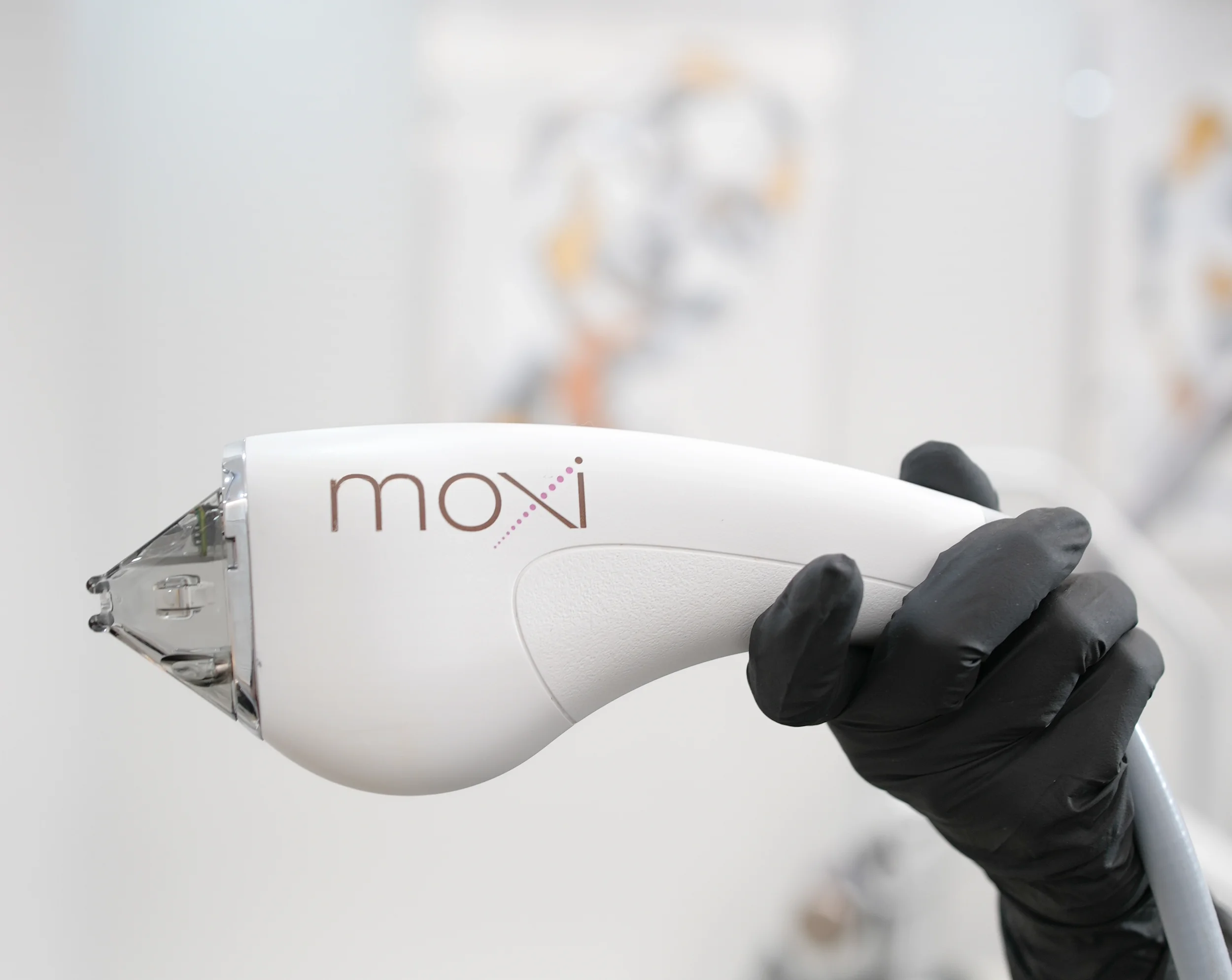
So how does MOXI actually work?
MOXI is a non-ablative fractional laser that uses a 1927nm wavelength to deliver controlled laser energy into the skin.
The way I usually explain this to patients is that we're creating thousands of tiny, controlled micro-injuries within the skin.
We're only treating a fraction of the skin at a time, which is where the name fractional laser comes from.
This stimulates the skin's natural repair processes, encouraging cellular renewal and collagen remodelling, while leaving the surrounding tissue intact.
Because MOXI doesn't remove the surface of the skin in the way that an ablative laser does, we can achieve noticeable improvements with relatively little downtime.
It's particularly fantastic for treating pigmentation and sun damage, but we also use it to improve fine lines, uneven texture and overall skin quality.
And this is where the research gets even more interesting.
Researchers are investigating how stimulating the skin's repair processes might influence the damaged cells that accumulate after years of sun exposure.
One area of interest is the role of fibroblasts, the cells responsible for producing collagen and helping maintain the structure of our skin.
As we age, changes in these cells can affect the surrounding skin environment. Research suggests that fractional laser treatments may help remodel this environment, potentially influencing some of the processes associated with skin cancer development.
So we're not just looking at how the skin appears on the surface, but what's happening within the tissue itself.
An 86.6% reduction in precancerous skin changes
Another study, published in the Journal of the American Academy of Dermatology, investigated a 1927nm fractional laser, the same wavelength used by MOXI.
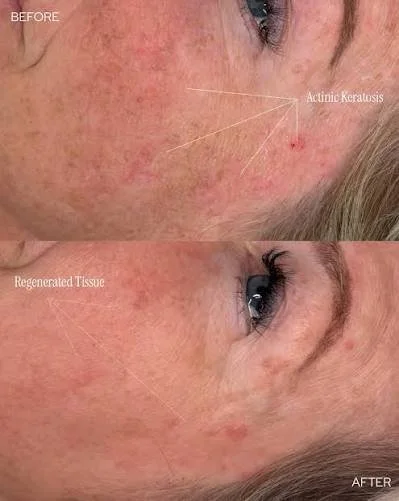
Researchers looked at something called actinic keratoses.
These are rough, scaly patches that develop after years of sun exposure. They're considered precancerous because some can eventually develop into squamous cell carcinoma.
The study involved 24 patients who received up to four laser treatments.
Six months later, researchers reported an 86.6% reduction in actinic keratoses.
That's a substantial improvement in precancerous skin changes.
And it's particularly interesting because MOXI uses this same 1927nm wavelength, which is already fantastic for improving visible sun damage and pigmentation.
The possibility that this technology could have wider benefits for skin health is something I find genuinely exciting.
Courtesy of Evri Aesthetics
More than just skin rejuvenation
When I first looked into investing in laser technology, I actually sent out a questionnaire to our patients to find out what they wanted.
The feedback was pretty clear. People wanted results, but they didn't want weeks of downtime.
I'd considered more aggressive CO2 laser resurfacing, but it wasn't the right fit for what our patients were asking for.
MOXI was a fantastic addition alongside BBL HERO because it allowed us to improve pigmentation, sun damage, fine lines and skin texture with much less recovery time.
And it's been a brilliant addition to the treatments we offer at The Good Skin Guru.
But discovering this research has made me even more excited about the technology.
We already know how much improving someone's skin can affect their confidence. I've seen patients who haven't felt like themselves for years become so much more comfortable in their own skin.
That alone is incredibly rewarding.
But the possibility that the same technology could also play a role in improving long-term skin health is something I find amazing.
There's still plenty more to learn about these potential benefits, and I'll certainly be keeping an eye on the research as it develops.
For now, MOXI remains one of my favourite treatments for improving pigmentation, sun damage and overall skin quality, and I'm excited to see what else we discover about this technology in the years ahead.
MOXI laser treatments in Cockermouth, Cumbria
At The Good Skin Guru, we offer Sciton MOXI and BBL HERO treatments to help patients improve pigmentation, redness, sun damage, fine lines and overall skin quality.
Whether you're starting to notice changes in your skin or have been struggling with pigmentation for years, we can assess your skin and recommend the most suitable treatment.
If you'd like to find out whether MOXI laser treatment in Cockermouth could be right for you, get in touch with us to arrange a consultation.
Cheryl
Advanced Nurse Practitioner
The Good Skin Guru
Scientific references
Benson TA et al. (2023). Nonablative Fractional Laser Treatment Is Associated With a Decreased Risk of Subsequent Facial Keratinocyte Carcinoma Development. Dermatologic Surgery.
Weiss ET et al. (2013). 1927-nm fractional resurfacing of facial actinic keratoses: a promising new therapeutic option. Journal of the American Academy of Dermatology.